Thursday, July 10, 2014

Camping - Day 1 notes

*Fourth of July -- You would think a public campground would be overrun with fireworks-crazy revelers on 7/4. One of the first things we saw at Bagley Rapids was a sign stating "Fireworks Prohibited in Campground." We did hear a fireworks display after sundown, perhaps from a nearby town. There were still a few fireworks late at night in the distance, but nothing that interrupted sleep (thankfully).

The working burner, on the left.
*A new stove -- We finally took the plunge and bought a two-burner propane camping stove. We were excited to use it on the trip. Some people may know that I've struggled with stoves in the past (see: MSR Whisperlite). So it wasn't a surprise when one of the two burners did not work on the new stove. To top things off, in perhaps a related issue, the fuel canister gushed propane upon removal from the stove.

*Wildlife -- The bird highlight of the day was an osprey over Highway 141 in Wisconsin. Ovenbirds were plentiful in the campground. There also were red squirrels and chipmunks. And it was fun to be far enough north to see ravens.

Camping - Day 1

Forgive this bit of navel gazing, but I haven't blogged for a while and wanted to capture a memorable trip with the kids.

Friday, July 4, dawned clear and cool in Chicago. The forecast was for mild temperatures and sun across the Great Lakes. We were preparing for a drive to northern Wisconsin, exact destination unknown. Still, the car was laden with camping equipment and other provisions for a family of four, including children ages 4 and 15 months. We had no room to spare in the car--a day pack rode at my feet in the passenger side.

The CRV, packed to the gills.
The ride out of Chicago was uneventful, without a stop until Manitowoc, well north of Milwaukee. Sonja's first comment of "I want to go home" came somewhere around Skokie on I-94--not a good sign--but Celeste slept well (it was her usual nap time). By 1 we were approaching our target destination: Bagley Rapids Campground, Nicolet National Forest, near Mountain, Wis. This is about an hour northwest of Green Bay. We were nearly there when we encountered a tangly detour and highway closure near Pound, Wis. We drove east to go west at one point, but soon were approaching Bagley Rapids. The terrain transitioned from farmland to forest along the way.

I had made reservations for two July nights at Wells State Park, in Michigan, sometime in May. The original plan was for a simple Lake Michigan circle tour. But plans changed and we ended up needing to leave July 4, one day before our Wells reservation, if we were to get a three-night trip in. We scanned for online reservations of campsites in northern Wisconsin and none were available. It didn't bode well for a small family looking for the ease of a reserved campsite and minimal driving. We didn't want to be driving vast distances in hopes of finding a site.

As we approached Mountain, we saw a small sign pointing to the south of the highway "National Forest Campground," three of the best words in the English language. ATVs, piloted by overly young children, whirred on snowmobile paths as we made our way toward the campground. We were relieved when we saw that a few sites would be available. In fact, we got a pretty site not far from the latrine and within earshot of the namesake rapids. We knew insect life would be one of the potential challenges of this trip, and we were indeed greeted by swarms of mosquitoes at our site. We applied bug spray to all of us and put on long sleeves. Soon enough, we had set up our tent and took a short walk to investigate the rapids.

Bagley Rapids, on the Oconto River
The girls adjusted to camping fairly well. We set up Sonja's potty in a clearing adjacent to our site. The mosquitoes were no fun. They massed in the vestibule of our tent, which we nicknamed Mosquito Garage. The girls slipped into and out of the tent quickly so as not to let any skeeters in. Sonja especially liked the tent and even spent some time alone reading a new Frozen book.

Celeste, table climber
Dinner was mac and cheese and hot dogs. Then the challenge of bedtime came. Kristin went in the tent with both girls near dusk. It was after their bedtime, and the long day and the thrill of camping did not encourage sleep. Both girls lolled about the tent--Celeste taking belly flops across piles of pillows and bedding. Sonja emerged from the tent at one point, and we talked about the moon, the fire and the stars. Finally, well after dark, the cries and queries from the tent slowed and eventually ended altogether.

Sunday, January 19, 2014

Yard birds

Typical view from our back porch.
A few years ago on a spring evening, I parked my car on our Chicago street and walked toward the front gate of our six-flat building. As I stepped on the sidewalk, I heard a tittering sound that I hadn't heard since standing in a Wisconsin prairie years before. A shadowy form burst from the ground and vaulted over the wrought-iron fence that frames our yard. It was an american woodcock, getting ready to spend the night in the very urban environs of the Uptown neighborhood.

Yard birding in an urban area is a very arbitrary and incredibly rewarding experience. Once, while I was parking on another congested North Side street, a Virginia rail ambled between cars and passersby. It was my lifer Virginia rail, and I was nowhere near a wetland.

I've kept a yard list at my last two Uptown addresses. Our previous home was situated on a North-South street: Kenmore Avenue. Neither home has had a yard any bigger than about 500 square feet. But the Kenmore building seemingly yielded more warbler species in the proper seasons--perhaps they followed the treetops of North-South Chicago streets as part of their migration. We tallied nearly 50 species in our five years at the location. Every year, almost to the day, we could count on a yellow-bellied sapsucker in a poplar that was clearly visible from our front window. It became a gratifying rite of April to see this bird.

For whatever reason, perhaps the East-West orientation, the yard list at our current home has taken longer to build. I decided that any bird seen or heard from the property would be counted as a yard bird. This opened up some great possibilities, including standing on our back porch and seeing birds from quite a long distance. That's resulted in peregrine falcon, black-crowned night-heron, great blue heron and some waterfowl. The total stands at 48, the last species a budgie on a frigid day--the bird likely an escape.

I still have a few target species--blue jay, common grackle, red-winged blackbird, fox sparrow, sandhill crane to name a few--but there's something fun about the low expectations and randomness of Uptown yard birding. Which will be the next new species? Probably not a Virginia rail.

Current list below:

American Woodcock
Canada Goose
House Sparrow
Rock Dove
American Robin
Northern Cardinal
Peregrine Falcon
American Kestrel
Chimney Swift
European Starling
White-throated Sparrow
House Finch
Mourning Dove
Ring-billed Gull
Black-crowned Night Heron
Dark-eyed Junco
Yellow-bellied Sapsucker
Chipping Sparrow
Killdeer
White-crowned Sparrow
Common Yellowthroat
Swainson's Thrush
Great Blue Heron
Brown Creeper
Black-capped Chickadee
Mallard
Gray Catbird
American Goldfinch
Ovenbird
Veery
House Wren
Common Nighthawk
Ruby-crowned Kinglet
Least Flycatcher
Eastern Wood-Pewee
Double-crested Cormorant
Yellow-rumped Warbler
Song Sparrow
Black-and-white Warbler
Golden-crowned Kinglet
Palm Warbler
Yellow Warbler
Eastern Phoebe
Cooper's Hawk
Hermit Thrush
Downy Woodpecker
American Crow
Budgerigar (likely escape)

Sunday, September 1, 2013

In writing

A few weeks ago, I had a few moments late one night and tried to summarize some recent thoughts on birding. I submitted the story to the Chicago Ornithological Society, which printed it in its July newsletter. Below is the text of the story. The funny thing is I did hardly any birding in the six weeks after the story until today when I was able to get in a pretty good day at Montrose (peregrine falcon, semipalmated sandpiper, semipalmated plover and sanderling the highlights). 


Birding…with children

By Bob Dolgan

Four years ago, before children, I had all the time in the world to go birding. But I didn’t. I played golf. I went backpacking. I biked on the lakefront path. Then I had children, and I actually started birding more.

I’ve birded since I was 8 years old, but it took having children to sharpen my priorities. The limits of nap schedules and early bedtimes ensure that. I’ve come to the conclusion that I don’t believe in traveling vast distances to chase rarities. But I do believe in seeing special birds when I can. I don’t believe in chasing a bird solely for a list. But I do believe in keeping track of the birds I see and hear.

Birding is the one hobby my wife and I can easily still do with the kids. The pace and duration are vastly different now, but the result has been more outings than ever. Having Montrose nearby is helpful. When my daughter was six months old, she would wake early on weekends and I would put her in a Baby Bjorn. We could get to Montrose in less than 10 minutes. I remember clearly the first time she noticed the presence of migrating birds. It was a crisp fall day and American Redstarts were singing from a grove of birches. She turned her head back and forth when she heard their songs.  

None of these early trips were long, as feeding and fresh diapers beckoned, but as we well know, you can pick up a number of species in a short time on the lakefront. Since then, we’ve graduated to a backpack carrier, and binoculars are now dangling from around my neck again. My older daughter, Sonja, now 3, knows the names of several birds—red-winged blackbird, chickadee, pigeon and crow to name a few. Sometimes the carrier becomes less appealing, and Sonja wants to be held. Often I have stood with my daughter in one arm while holding my binoculars up to my eye with the other, scanning treetops. Occasionally I’ve missed a good bird because of these awkward positions, I’m sure, but simply being in the field is worth it.

Earlier this year, in January, I took a day off and went birding. With my second daughter due in April, I thought it might be the last chance I’d have to bird for a while. The outcome was a little disappointing—just 27 species—but I had some time to myself, time I wouldn’t have anymore come April. Then the baby came, I was on leave from work and we birded quite a bit. We recorded 12 lists in April alone.

My birding renaissance has extended into summer, too. My wife and I took the children camping nearby (Chain O Lakes State Park), a location that was close to a place where it was possible to see a lifer without driving far out of the way. Growing up in Northeast Ohio, my odds of seeing a Black Tern were slim. So we stopped off at a site on the way to the state park. Both kids were sleeping when we pulled up to the location. Thanks to the magic of eBird, the terns were right where they were supposed to be. I watched three flit through the air above a marsh. We were back on the road before the kids even woke up. Another success birding…with children.

Saturday, June 22, 2013

Good year

Montrose Dunes
It's hard to think about the first six months of birding in 2013 without thinking about our baby girl. Her birth April 8 had an interesting effect on the family birding patterns, though not what you might think. The year started with a trip to Door County that yielded several great birds and a couple of lifers. I took some time off at home around then, too, but managed only one full day of birding the Chicago area. Sure, species counts are limited when birding in January in the Midwest, but I was disappointed with the 27 species I saw on my big day. Then we had Celeste, and that's when things started getting interesting. In those fragile early days, we actually birded quite a bit--I submitted 15 checklists in April. The sparrowing was great--I saw 11 sparrow species in April. The return to work in May, though, made finding time to bird more difficult. May saw only eight checklists submitted. The warbler species tally was just 14--in one day it's very possible to see more than 14 warbler species at Montrose.
Overall, this spring's weather was more normal than 2012, when trees leafed out early (making birds hard to see) and the early warm fronts threw migration patterns out of wack.

I have 117 species on my Illinois 2013 list to date. Spring migration is the top opportunity to build a list, but birds can still be added with a few strategic trips. Last weekend, we went to Illinois Beach State Park. It's not far (about an hour), and we had never been there before even though it's pretty much the only natural Great Lakes beach/dune habitat in the state. I knew we had a shot to see some typical Midwestern birds that had escaped us at Montrose. And we did: belted kingfisher, eastern bluebird, eastern meadowlark and tree swallow were all added to the list. Then we added a goody: a Brewer's blackbird in the juniper-covered dunes.

We may do some camping in coming weeks and can look for more Illinois breeding species then. And there will be opportunities in fall migration, too. But the sightings will become more scarce as fall ends and winter approaches.

Tuesday, February 12, 2013

Opening Door

The Door Peninsula of Wisconsin extends dozens of miles north into Lake Michigan from near Green Bay, Wis. Until last month, we'd never been to this idyllic part of the world. The peninsula is part of the Niagara escarpment that rings the western Great Lakes. So even while we were on the same lake as flat, sandy Chicago, the rocky coastlines and bluffs felt a million miles away from home. 

We chose Door County for a winter getaway unintentionally. I checked into rentals in Wisconsin, hoping to stay close to home, and Door County offered the most options. Then I found a cabin in the tiny Gills Rock community, at the northernmost tip of the pleasant peninsula. The dramatic location was too much to resist. 

In this mild winter, we didn't see snow until we were halfway up the peninsula at Sturgeon Bay. We continued northward on dark, winding, two-lane roads until we pulled up to our cabin at midnight on a Friday. The cabin itself was interesting--a restored mid-19th-century cabin that turned out to be very comfortable and (thankfully) well-heated. 

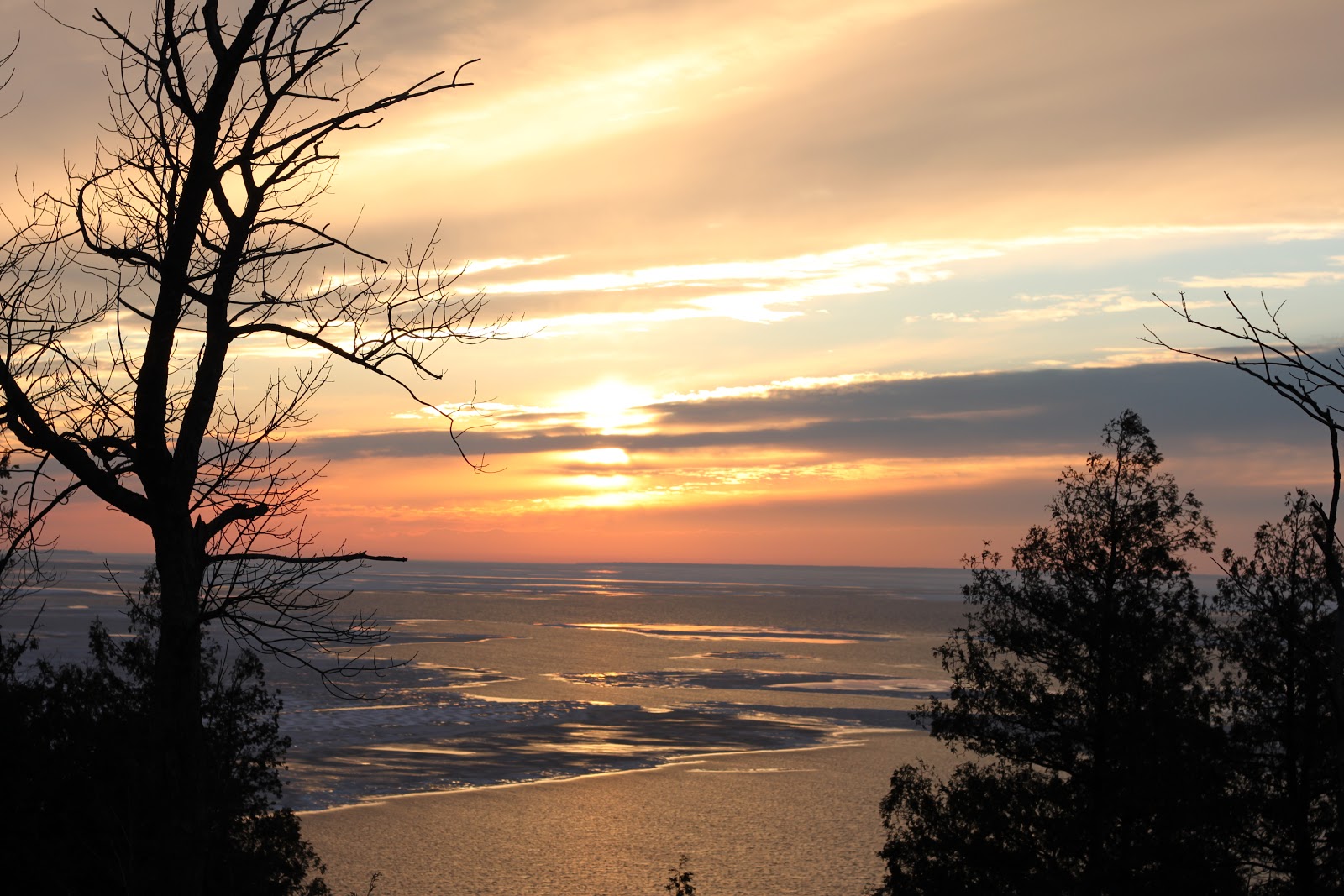
We didn't realize until dawn that Lake Michigan was in plain view, across the street from the cabin. We woke to a beautiful snowfall on morning No. 1 and the temperatures began to plummet. I knew there was a chance to see some winter Wisconsin bird specialties, and within a few minutes we saw a flock of white-winged crossbills in the trees between us and the lake. A life bird! We did a little exploring that day including a trip to Ellison Bluff County Park, where we saw a beautiful sunset (above). 

On Day 2, we traveled south to Egg Harbor only to realize that most of the shops and restaurants in the quaint Door towns were closed for the season. Still, we saw a good bit of the area and another life bird--a flock of Bohemian waxwings in berry trees along the side of the road in Fish Creek. This variety of waxwing, which lives in the Arctic half the year, is larger than cedars and has a rusty undertail. We also stopped at the tiny Pioneer General Store, the nearest grocery to us.

The temperature was below zero when we set out on the morning of Day 3. We drove around the peninsula and listened to the inauguration festivities. We explored the east side of the county, which is lower in elevation and seemingly more remote. We crisscrossed farmland and saw a couple of other winter specialties--a northern shrike and a rough-legged hawk. We had passed a tiny sign for a Jens Jensen visitor center in Ellison Bay and decided to go back late in the day. Jensen designed a number of well-known parks including Columbus Park in Chicago, where we were married. We discovered that he had created a folk school, The Clearing, in Ellison Bay.  The site was meant to replicate his native Denmark, complete with a bluff facing the western afternoon sun.

We headed back to Chicago in the subzero temperatures on Tuesday and made remarkably good time--about 4.5 hours. It's comforting to know that such an escape is a half-day's drive away.

It's Caillou

To the writers of Caillou --

The episode shown on Sprout on 12 February 2013 at 6:30 p.m. Central time included a scene where Caillou woke in the night from a bad dream. Caillou's dad went to check on him, and Caillou said that he had a dream about a scary monster. If this wasn't enough, the next scene showed Caillou frightened by a shadow on the wall that he thought was a monster (it turned out to be a shadow of a dinosaur doll he had). This scared Caillou to the point where he went to Mom and Dad's room and asked to come to bed with them. The scene led to a sleepless night for the whole family.

The primary audience for Caillou is toddlers, and children under the age of 5 are highly impressionable. There are many thoughts, deeds and words that my wife and I hide from our daughter so that we don't "plant a seed" in her mind. For example, I would never come home from work and open a candy bar in front of my daughter. There's no doubt she would see the candy bar and immediately request a bite from the bar. I also wouldn't come home and ask my wife if we were going to the zoo the next day. The mention of the zoo would cause Sonja so much excitement that any change of plan would lead to a dramatic letdown. Finally, even if I thought say making cookies would be fun, I wouldn't mention it if there wasn't time or if we didn't have the ingredients. I'm finding discipline and restraint are two key tenets of parenting. 

There are good habits we are trying to instill in our daughter -- potty training, courtesy and patience come to mind -- that your program could model for young children. By showing this sleep catastrophe on your program, children now may think it's OK to wake their parents, complain of monsters and crawl into bed. Parents choose toddler TV programming and line the pockets of your advertisers. They also never have enough sleep. You can appeal to both children and parents by omitting the stuff that gives us nightmares.