Saturday, November 8, 2014
Dune adventure
Sunday, July 13, 2014
Camping - Day 3 notes
*Beer -- We arrived with a Chicago IPA--Revolution Brewing's Anti-Hero--as well as Bell's Oberon. Along the way, we purchased a six-pack of Blackrocks Brewery's 51K IPA, from Marquette, Mich., and Bell's Two-Hearted Ale. As the Two-Hearted label states, ideal for "Hemingway-esque" trips to the Upper Peninsula. We stuck with Whole Foods' 365 brand organic whole milk for the girls.
*Wildlife -- It was a thrill to hear and see two loons in Lake Michigan, right off our campsite. Also, we saw a bald eagle soaring above Route 41, near Peshtigo, Wis. Perhaps the most stunning sight of all was at least two dozen American white pelicans soaring over the city of Green Bay, which has a thriving breeding population. Fun.
Friday, July 11, 2014
Camping - Day 3
The out-and-back hike traverses rolling terrain for about 2.5 miles. Along the way there are four "piers," rock outcrops that lead to nice overlooks of the river. We also crossed two "troll" bridges, little wooden bridges over a pair of small creeks. White pines towered along the trail, some of the trees at least 2 feet across. The dense forest and damp conditions gave the gorge a Pacific Northwest feel.
After the hike, we drove to the mining town of Iron Mountain in search of lunch. We opted to go to a well-known pizza chain, one that encloses each of its locations with the same geometric red roofs. I honestly haven't been to one of the red-roofed locations in decades, but it proved a solid choice for the children and a nice respite after the hike.
All trip long we had discussed what we'd do if Sonja needed to use the potty in certain scenarios. We were stopped at a grocery store when Sonja volunteered that she needed to go potty. With Celeste in her car seat it seemed reasonable to stay near the car so I made the dubious decision to put the potty on the passenger seat. I then deposited Sonja onto the potty. She peed, yes, but getting down from the perch proved a challenge and some of the urine sloshed over the lip of the plastic commode and onto the passenger seat. I mopped up what I could but ended up sitting on a changing mat all the way back to the campground. Lesson learned.
It started to rain again as we approached camp, but we managed to stay dry. It eventually stopped raining long enough to make a nice fire, and we had hot dogs and mac and cheese again for dinner. Sonja and I went to a swing set in the evening and had ice cream at a nearby gas station -- Sonja opting for a sundae cone and a strawberry shortcake crunch for me.
Thursday, July 10, 2014
Camping - Day 2
We stopped for lunch across the border in Menominee, Mich. It was a lot windier there, right along Lake Michigan, but the temperatures were pleasant. There was a playground, and we spent a lot of time at the swings. We got lunch to-go from a little cafe-type place and ate on a blanket in a park along the waterfront.
Wells State Park was only about 20 minutes north of Menominee. Why Wells? I had a faint memory of passing by the park a few years ago and thinking that the section of Lake Michigan coast seemed very pleasant. While only 4.5 hours north of Chicago, it feels like the true north--conifers, birches, wetlands and rocky Great Lakes beaches. The whole setting resembles muskeg.
We lucked into one of the three best sites at Wells. The majority of sites at the park are in a crowded loop filled with RVs. We had reserved a rustic site perhaps a mile from the RV area. We pulled up to our site and encountered a group of friendly people playing bocce in the grass. The site was broad and grassy, with a nice view of Lake Michigan, about 50 yards away. There was a birdhouse in the woods, occupied by house wrens. We set up our things and took a walk down to the lake.
We were determined to have a better bedtime experience, so Kristin took Sonja to get ice cream back at the camp office around sunset. I rocked and rocked Celeste in the tent until she went to sleep. The strategy worked, though Celeste briefly stirred when we all went to bed.
Camping - Day 1 notes
| The working burner, on the left. |
*Wildlife -- The bird highlight of the day was an osprey over Highway 141 in Wisconsin. Ovenbirds were plentiful in the campground. There also were red squirrels and chipmunks. And it was fun to be far enough north to see ravens.
Camping - Day 1
Friday, July 4, dawned clear and cool in Chicago. The forecast was for mild temperatures and sun across the Great Lakes. We were preparing for a drive to northern Wisconsin, exact destination unknown. Still, the car was laden with camping equipment and other provisions for a family of four, including children ages 4 and 15 months. We had no room to spare in the car--a day pack rode at my feet in the passenger side.
![]() |
| The CRV, packed to the gills. |
I had made reservations for two July nights at Wells State Park, in Michigan, sometime in May. The original plan was for a simple Lake Michigan circle tour. But plans changed and we ended up needing to leave July 4, one day before our Wells reservation, if we were to get a three-night trip in. We scanned for online reservations of campsites in northern Wisconsin and none were available. It didn't bode well for a small family looking for the ease of a reserved campsite and minimal driving. We didn't want to be driving vast distances in hopes of finding a site.
As we approached Mountain, we saw a small sign pointing to the south of the highway "National Forest Campground," three of the best words in the English language. ATVs, piloted by overly young children, whirred on snowmobile paths as we made our way toward the campground. We were relieved when we saw that a few sites would be available. In fact, we got a pretty site not far from the latrine and within earshot of the namesake rapids. We knew insect life would be one of the potential challenges of this trip, and we were indeed greeted by swarms of mosquitoes at our site. We applied bug spray to all of us and put on long sleeves. Soon enough, we had set up our tent and took a short walk to investigate the rapids.
| Bagley Rapids, on the Oconto River |
![]() |
| Celeste, table climber |
Sunday, January 19, 2014
Yard birds
| Typical view from our back porch. |
Yard birding in an urban area is a very arbitrary and incredibly rewarding experience. Once, while I was parking on another congested North Side street, a Virginia rail ambled between cars and passersby. It was my lifer Virginia rail, and I was nowhere near a wetland.
I've kept a yard list at my last two Uptown addresses. Our previous home was situated on a North-South street: Kenmore Avenue. Neither home has had a yard any bigger than about 500 square feet. But the Kenmore building seemingly yielded more warbler species in the proper seasons--perhaps they followed the treetops of North-South Chicago streets as part of their migration. We tallied nearly 50 species in our five years at the location. Every year, almost to the day, we could count on a yellow-bellied sapsucker in a poplar that was clearly visible from our front window. It became a gratifying rite of April to see this bird.
For whatever reason, perhaps the East-West orientation, the yard list at our current home has taken longer to build. I decided that any bird seen or heard from the property would be counted as a yard bird. This opened up some great possibilities, including standing on our back porch and seeing birds from quite a long distance. That's resulted in peregrine falcon, black-crowned night-heron, great blue heron and some waterfowl. The total stands at 48, the last species a budgie on a frigid day--the bird likely an escape.
I still have a few target species--blue jay, common grackle, red-winged blackbird, fox sparrow, sandhill crane to name a few--but there's something fun about the low expectations and randomness of Uptown yard birding. Which will be the next new species? Probably not a Virginia rail.
Current list below:
| American Woodcock |
| Canada Goose |
| House Sparrow |
| Rock Dove |
| American Robin |
| Northern Cardinal |
| Peregrine Falcon |
| American Kestrel |
| Chimney Swift |
| European Starling |
| White-throated Sparrow |
| House Finch |
| Mourning Dove |
| Ring-billed Gull |
| Black-crowned Night Heron |
| Dark-eyed Junco |
| Yellow-bellied Sapsucker |
| Chipping Sparrow |
| Killdeer |
| White-crowned Sparrow |
| Common Yellowthroat |
| Swainson's Thrush |
| Great Blue Heron |
| Brown Creeper |
| Black-capped Chickadee |
| Mallard |
| Gray Catbird |
| American Goldfinch |
| Ovenbird |
| Veery |
| House Wren |
| Common Nighthawk |
| Ruby-crowned Kinglet |
| Least Flycatcher |
| Eastern Wood-Pewee |
| Double-crested Cormorant |
| Yellow-rumped Warbler |
| Song Sparrow |
| Black-and-white Warbler |
| Golden-crowned Kinglet |
| Palm Warbler |
| Yellow Warbler |
| Eastern Phoebe |
Cooper's Hawk
Hermit Thrush
Downy Woodpecker
American Crow
Budgerigar (likely escape)
|
Sunday, September 1, 2013
In writing
Saturday, June 22, 2013
Good year
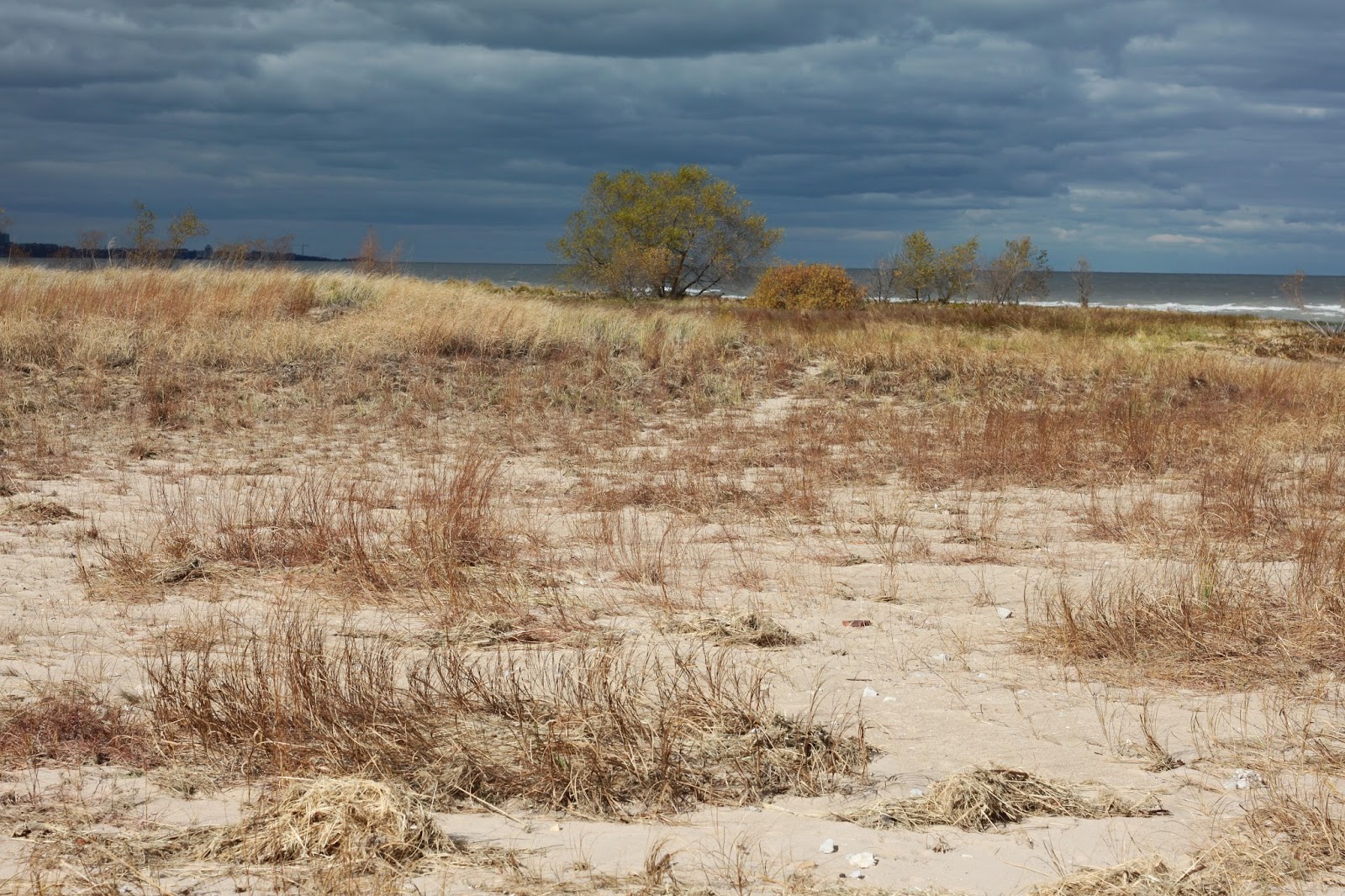
| Montrose Dunes |
Overall, this spring's weather was more normal than 2012, when trees leafed out early (making birds hard to see) and the early warm fronts threw migration patterns out of wack.
I have 117 species on my Illinois 2013 list to date. Spring migration is the top opportunity to build a list, but birds can still be added with a few strategic trips. Last weekend, we went to Illinois Beach State Park. It's not far (about an hour), and we had never been there before even though it's pretty much the only natural Great Lakes beach/dune habitat in the state. I knew we had a shot to see some typical Midwestern birds that had escaped us at Montrose. And we did: belted kingfisher, eastern bluebird, eastern meadowlark and tree swallow were all added to the list. Then we added a goody: a Brewer's blackbird in the juniper-covered dunes.
We may do some camping in coming weeks and can look for more Illinois breeding species then. And there will be opportunities in fall migration, too. But the sightings will become more scarce as fall ends and winter approaches.
Tuesday, February 12, 2013
Opening Door
We chose Door County for a winter getaway unintentionally. I checked into rentals in Wisconsin, hoping to stay close to home, and Door County offered the most options. Then I found a cabin in the tiny Gills Rock community, at the northernmost tip of the pleasant peninsula. The dramatic location was too much to resist.
In this mild winter, we didn't see snow until we were halfway up the peninsula at Sturgeon Bay. We continued northward on dark, winding, two-lane roads until we pulled up to our cabin at midnight on a Friday. The cabin itself was interesting--a restored mid-19th-century cabin that turned out to be very comfortable and (thankfully) well-heated.
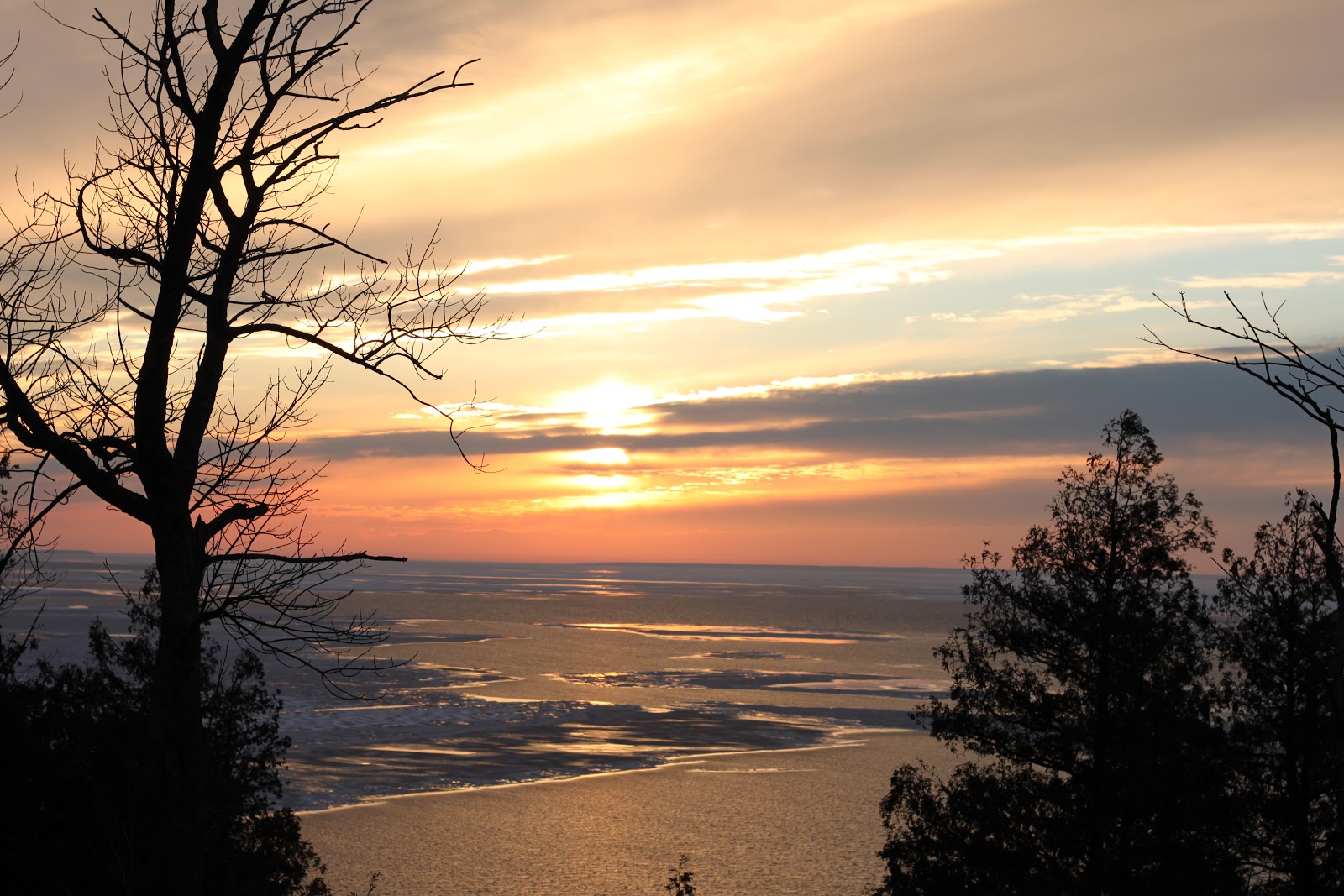
We didn't realize until dawn that Lake Michigan was in plain view, across the street from the cabin. We woke to a beautiful snowfall on morning No. 1 and the temperatures began to plummet. I knew there was a chance to see some winter Wisconsin bird specialties, and within a few minutes we saw a flock of white-winged crossbills in the trees between us and the lake. A life bird! We did a little exploring that day including a trip to Ellison Bluff County Park, where we saw a beautiful sunset (above).
On Day 2, we traveled south to Egg Harbor only to realize that most of the shops and restaurants in the quaint Door towns were closed for the season. Still, we saw a good bit of the area and another life bird--a flock of Bohemian waxwings in berry trees along the side of the road in Fish Creek. This variety of waxwing, which lives in the Arctic half the year, is larger than cedars and has a rusty undertail. We also stopped at the tiny Pioneer General Store, the nearest grocery to us.
The temperature was below zero when we set out on the morning of Day 3. We drove around the peninsula and listened to the inauguration festivities. We explored the east side of the county, which is lower in elevation and seemingly more remote. We crisscrossed farmland and saw a couple of other winter specialties--a northern shrike and a rough-legged hawk. We had passed a tiny sign for a Jens Jensen visitor center in Ellison Bay and decided to go back late in the day. Jensen designed a number of well-known parks including Columbus Park in Chicago, where we were married. We discovered that he had created a folk school, The Clearing, in Ellison Bay. The site was meant to replicate his native Denmark, complete with a bluff facing the western afternoon sun.
We headed back to Chicago in the subzero temperatures on Tuesday and made remarkably good time--about 4.5 hours. It's comforting to know that such an escape is a half-day's drive away.
It's Caillou
The episode shown on Sprout on 12 February 2013 at 6:30 p.m. Central time included a scene where Caillou woke in the night from a bad dream. Caillou's dad went to check on him, and Caillou said that he had a dream about a scary monster. If this wasn't enough, the next scene showed Caillou frightened by a shadow on the wall that he thought was a monster (it turned out to be a shadow of a dinosaur doll he had). This scared Caillou to the point where he went to Mom and Dad's room and asked to come to bed with them. The scene led to a sleepless night for the whole family.
The primary audience for Caillou is toddlers, and children under the age of 5 are highly impressionable. There are many thoughts, deeds and words that my wife and I hide from our daughter so that we don't "plant a seed" in her mind. For example, I would never come home from work and open a candy bar in front of my daughter. There's no doubt she would see the candy bar and immediately request a bite from the bar. I also wouldn't come home and ask my wife if we were going to the zoo the next day. The mention of the zoo would cause Sonja so much excitement that any change of plan would lead to a dramatic letdown. Finally, even if I thought say making cookies would be fun, I wouldn't mention it if there wasn't time or if we didn't have the ingredients. I'm finding discipline and restraint are two key tenets of parenting.
There are good habits we are trying to instill in our daughter -- potty training, courtesy and patience come to mind -- that your program could model for young children. By showing this sleep catastrophe on your program, children now may think it's OK to wake their parents, complain of monsters and crawl into bed. Parents choose toddler TV programming and line the pockets of your advertisers. They also never have enough sleep. You can appeal to both children and parents by omitting the stuff that gives us nightmares.
Monday, December 31, 2012
2012 Year in Review: Tent revival
The year proved to be a camping bonanza after a lengthy period without sleeping under the stars. Our Mountain Hardwear tent literally fell apart at the seams in Michigan so we bought a Big Agnes four-person tent, complete with a "garage" vestibule that makes it look like a nylon igloo. Eager to use the new tent and spurred by the fun of the Michigan trip, we embarked on two fall one-nighters--the first to Apple River Canyon State Park and the second to Marengo Ridge.
Apple River Canyon is a series of bluffs and odd formations on a small tributary of the Mississippi River in Northwest Illinois. It's part of the namesake Driftless Area and offers a number of short hiking options. We dodged remnants of a recent hurricane and managed to get to the campground dry. Temperatures were comfortable in the 60s. Highlights included a Tennessee warbler in our campsite, a nice fall migrant to discover. We also had an apple tree in our site, complete with ripe apples, and were able to munch on a few. We took one hike, to Tower Rock, a pinnacle several stories up from the valley floor. We then had lunch in Savanna, Ill., where we watched barges on the Mississippi. We drove through Upper Mississippi NWR to Lock and Dam 13, typically a mecca for bald eagles, but not in the summer apparently. We did see lots of wood ducks and great egrets in the refuge.
Our final trip of the season was to Marengo Ridge, a McHenry County Conservation District site about 60 miles from Chicago. The campgound is perched atop a moraine with a nice view of the surrounding countryside and the Kishwaukee River Valley. We had a private site as the campground was only half full. It's really a terrific locale so close to Chicago. We again enjoyed staking the Big Agnes and managed to stay warm on a cold night in the 30s. The evening highlight was a great horned owl hooting, a nice addition to my 2012 Illinois list. We stopped at the Illinois Railway Museum on the way back the next day. We rode on a vintage Chicago streetcar; overall the museum was a lot of fun--it's massive and there's a lot there we didn't see. Our five nights camping in 2012, most since 2009, were fantastic.
Saturday, December 29, 2012
2012 Year in Review: Rainbow warriors
Birds were plentiful. We went to Kealia Pond National Wildlife Refuge, where we saw the rare Hawaiian stilt, wandering tattler, Pacific golden plover and a few more. I recorded a lifer tropicbird along the Kahekili Highway.
Hawaii is an amazing place, and I wish we had more time for hiking in some of the mountain areas or a trip to Molokini Crater. The other islands look very interesting, too.
Friday, December 28, 2012
2012 Year in Review: Hot stuff
We had booked our three-night trip months in advance. Van Buren is a popular spot--just two hours from Chicago in the popular Harbor Country of Southwest Michigan. So it wasn't a surprise that the campground was full. Our spot was on the fringe of the campground and didn't offer much in the way of shade. We set up our tent at the edge of a forest and nabbed some shade for the morning hours. The friends we were meeting there had a nice corner spot that largely was forested--we spent much of our time at their site.
The highlight of Van Buren is the beach, which is wide and sandy, at the foot of a steep dune. The water felt great every time we went in. My friend Cub parked a lawn chair in a small pop-up shelter. From the water, he appeared to be a light-beer-swilling monarch, overseeing his sandy realm from his beach hut.
The heat persisted for two days. Amazingly, a weak cold front moved through, accompanied by morning thunderstorms. It cooled everything just enough and we had a wonderfully cool morning to sleep in, and yes the toddler slept in, too. Even when the seams broke on our tent, we stayed dry.
All in all, it was a great trip. We explored the town of South Haven and drove past a number of u-pick blueberry farms. We got to know the scenic Blue Star Highway that runs along the coast north of Benton Harbor. The trip proved that it's worth going even in the worst weather conditions.
Thursday, December 27, 2012
2012 Year in Review: Good coppice
Friday, December 7, 2012
Good year
A few weeks ago, we finally saw the movie The Big Year on DVD. It's probably the most prominent movie ever made about birding. It's certainly the most expensive, reportedly costing $40 million to make.
The Big Year features an all-star cast: Owen Wilson, Steve Martin and Jack Black. In seeing the trailers, I feared that the movie would strive to make fun of birders--an easy target to be sure. With a few small exceptions, that was not the case at all. In fact, the movie took care to portray birding accurately and kindly. That may have been why the movie was a big failure at the box office, grossing less than $10 million in the United States.
Casting Wilson as a cocky, world-renowned birder was pure brilliance. Martin and Black were both subdued and likable as they chased Wilson around the country trying to keep up with his North American big year. The bit players were good, too, including Rashida Jones as Black's love interest and Brian Dennehy as Black's curmudgeonly father.
I remember some birders being dismayed when The Big Year came out. But it really does mostly get it right, any quibbles are nitpicks at best (would a whistling-duck really hang out at the top of a mountain?). I highly recommend The Big Year!
Wednesday, February 1, 2012
Western phoebe
I spent some time last week in San Jose, Calif. I went for a morning walk around the center of the city--the ninth-largest city in the United States. San Jose sits in a valley just south of the San Francisco Bay. The Guadelupe River flows through the center of town and is flanked by a recreational trail. The river is really no more than a creek in a little ravine lined with sycamores and other riparian trees. It was there, in the shadow of the headquarters of Adobe (above), that I saw my lifer black phoebe. The bird isn't uncommon in its range along the West Coast. Like the eastern phoebe, it spends time near bridges and branches hanging over streams.
Sunday, January 22, 2012
Winter recess
While the hills never rise to more than about 1,100 feet, southern Ohio is quite rugged. The southeast quarter of Ohio is a sea of steep ridges and deep valleys. In a few hidden, idyllic spots there are high-walled gorges and waterfalls. Rarer are recess caves, huge sandstone overhangs carved by erosional forces. In winter, the area is made all the more spectacular by a coating of snow and massive ice formations. The flora is that of a much more northerly place, in some places hemlock-laden ravines stranded by the last glaciation. Above is Cedar Falls, the 50-foot high waterfall on Queer Creek, part of Hocking Hills State Park. A few miles away is Old Man's Cave, the largest recess cave in Ohio (top). The area has many hiking, backpacking and camping options. I recommend it in the off-season, when the crowds are away and temperatures are a bit cooler.